
INDEPENDENCE!
Independence is an important tenet of trusted nonprofit Board Governance. For a variety of reasons, it’s best for a nonprofit if a majority of the Board members are independent and not related through business or family connections.
And Independence is very important to the IRS and nonprofit community, which is why there are questions on page 1 AND on page 6 of the Form 990 about the number of Board members and how many are independent. And it can be an important consideration in many grant applications as an indicator of Best Practices for nonprofit governance.

With a newly formed nonprofit, it’s common that some of the Board members may be related by family or business connections. This is understandable in the initial stages of a nonprofit, but may hinder future fundraising, as the benefit to the family or the for-profit business could be seen as an influence on decision making.
As the nonprofit moves past the initial start up stage, it’s important to expand the Board and add new members, persons with added skills or connections or resources. And to add members that are NOT related.
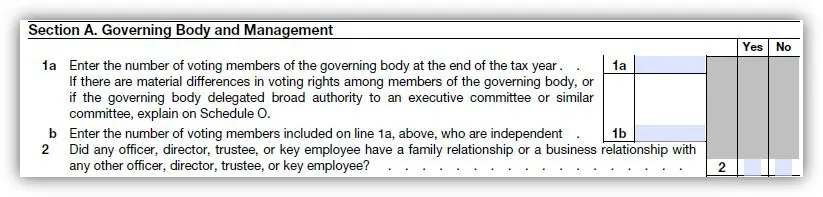
I typically recommend that each Board member identify one or two new Board member candidates to nominate before the end of the first year of operations. Using a Board member application will help the other Board members get to know the candidate and evaluate what each candidate has to offer.
Once the Board agrees on a list of approved nominees, it is highly beneficial to invite each nominee to attend a Board meeting as a guest, so they meet the other members and better understand the nonprofit’s mission, purpose, and operations. Alternatively, the Executive Director and a few Board members might meet the candidates at the nonprofit offices for a good get-to-know you meeting.
After the meetings with nominees, the Board should review the nominee list at a Board meeting and vote on which nominees to invite, and the role they would play on the Board.
The Secretary or Vice-President would typically be the person to manage the nominee applications and elections.
Once the Board has voted on the approved nominees, the new Board members will be invited to the next Board meeting and begin to support the nonprofit in its mission, purpose, and operations. It is immensely helpful if one Board member helps with the onboarding process to review processes and answer questions.
Once this cycle of annual nominations becomes part of the nonprofit’s routine, the Board will continue to grow and bring new opportunities to the nonprofit.
And page 1 of that Form 900 will be looking mighty fine.
If you would like help with this process, please feel free to reach out to us. We’re happy to help.
Great insights—this really highlights something that a lot of new nonprofits overlook in the early stages. Building a board from trusted friends and family is often the natural starting point, but your point about intentionally transitioning toward independence is so important for long-term credibility and growth.
I especially appreciate the practical steps you outlined for identifying and onboarding new board members. Inviting nominees to attend a meeting as guests is a smart way to ensure alignment and set expectations on both sides.
This is a helpful reminder that strong governance doesn’t happen by accident—it takes intentional structure and ongoing effort. Thanks for breaking this down so clearly!
Great guidance as usual, Carol.
Your overarching theme — maintaining an independent board — is a foundational component of strong board governance.
I’d add that it’s not only important to refrain from adding family members or close business colleagues, but also bring on board members that are close friends with the founders or executive staff. Maintaining independence is key.